Rejuvenation
Aesthetics and Beauty: A Guide to Confident Choices
In the world of self-care, the terms 'aesthetics' and 'beauty' are often used interchangeably. Understanding their distinct meanings is the first step towards a more confident and empowered relationship with your appearance.
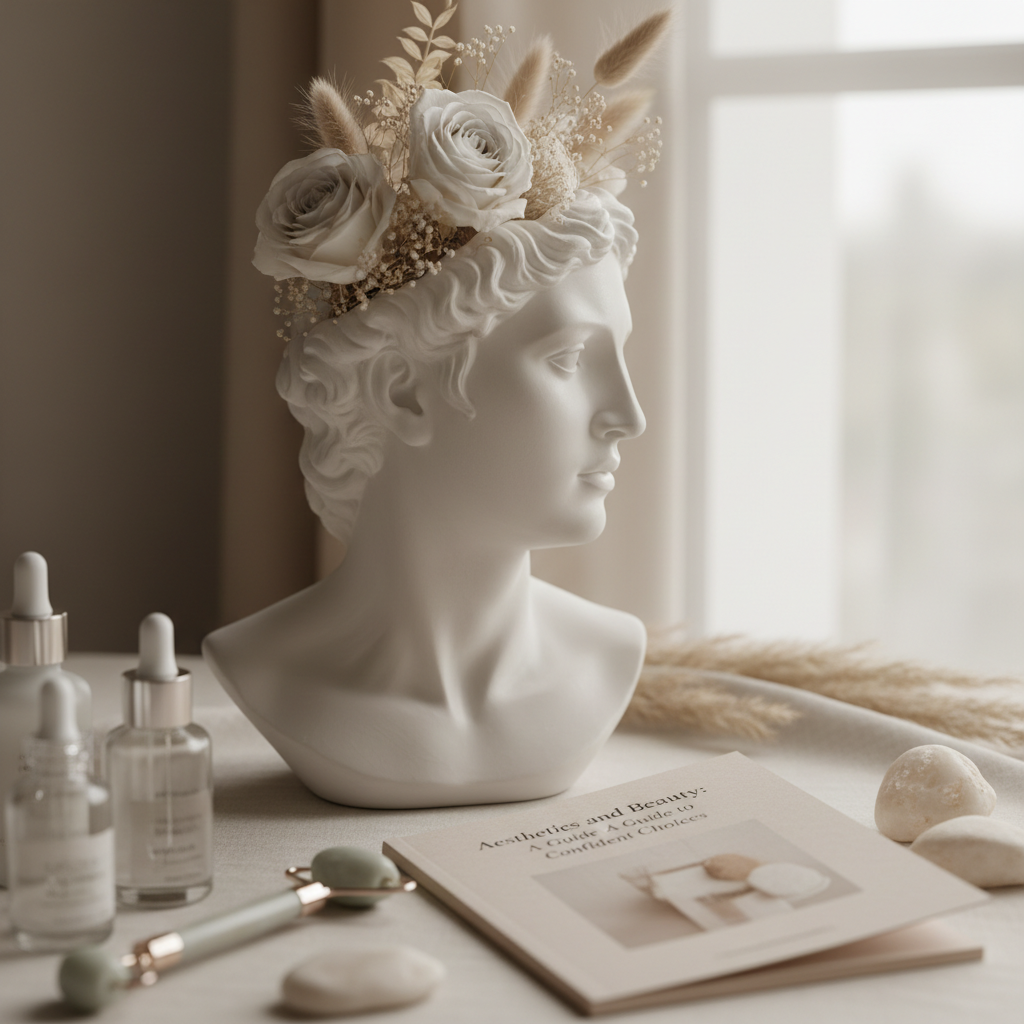
In the modern lexicon of self-care, the words 'aesthetics' and 'beauty' are often tangled together, used to describe everything from a new serum to a clinical treatment. While they are deeply related, they are not the same. Grasping the delicate distinction between them is not merely a matter of semantics; it is the foundational step towards a healthier, more confident, and more empowered relationship with your appearance.
True, lasting self-confidence is an internal state of being. Yet, feeling that our external appearance is a genuine reflection of how we feel inside is a vital part of that ecosystem. Here, we explore the difference between these two powerful concepts, helping you to navigate your personal journey with clarity and intention.
Defining Beauty: An Innate Quality
Beauty is holistic and deeply personal. It is the intangible quality that makes a person, a piece of art, or a landscape captivating. It transcends perfect symmetry or flawless surfaces. Beauty is found in the unique character of a face, the warmth of a smile, the story told by laughter lines. It is an inherent quality, an essence that cannot be manufactured or applied.
Think of it this way: you can describe the technical skill of a painting—the brushstrokes, the use of colour, the composition. But the painting’s beauty is the feeling it evokes in you. It is subjective, resonant, and whole. In a person, beauty is the sum of their spirit, their expressions, and their physical form. It is not something to be ‘fixed’ or ‘achieved,’ because it is already present.
Understanding Aesthetics: The Science of Harmony
Aesthetics, on the other hand, is the branch of philosophy concerned with the principles of pleasing appearance, harmony, and proportion. It is a more technical, objective field. In the context of cosmetic medicine, aesthetics refers to the theory and practice of enhancing, refining, or restoring features to create a greater sense of balance and visual satisfaction.
An aesthetic practitioner uses their knowledge of anatomy, facial planes, and the way light interacts with skin to make subtle adjustments. These changes are guided by established principles, but always tailored to an individual’s unique facial structure. The goal is not to create a new face, but to honour the one that is already there.
Key aesthetic principles include:
- Symmetry and Balance: Creating a sense of equilibrium between the left and right sides of the face.
- Proportion and Scale: Ensuring that individual features exist in harmony with one another.
- Clarity and Texture: Improving the quality of the skin for a more radiant and healthy appearance.
- Definition and Contour: Enhancing the natural shadows and highlights that give the face its structure, such as the jawline or cheekbones.
The Intersection: Where Aesthetics Can Serve Beauty
This is where the two concepts elegantly meet. While aesthetic treatments cannot create beauty, they can be powerful tools for allowing an individual’s innate beauty to shine through more clearly.
The aim of a thoughtful aesthetic treatment is to align your outer appearance with your inner sense of self. For instance, you might feel vibrant and energetic, but find that genetic pre-dispositions or sun damage have led to skin laxity that projects an unwarranted tiredness. Or perhaps a deep-set frown line gives the impression of being cross when you feel perfectly serene.
In these instances, an aesthetic intervention—such as radiofrequency for skin firming or a neuromodulator to soften a static line—is not about chasing an ideal of perfection. Instead, it is about restoration and refinement. It is about removing a distraction, so that your appearance is a more accurate reflection of your spirit. The goal is to enhance, not to erase.
A Healthy Mindset for Your Aesthetic Journey
If you are considering an aesthetic treatment, approaching it with the right mindset is paramount for an outcome that truly bolsters your self-confidence.
Start with Self-Reflection
Before booking a consultation, ask yourself what you hope to achieve. The goal should always be to feel more like yourself. If your motivation is to look like a particular celebrity or to conform to a fleeting trend, it may be worth pausing. The most satisfying results come from a desire to subtly enhance your own unique features.
Choose a Practitioner Who Understands Nuance
A responsible and skilled clinician will do more than just assess your face in terms of what can be ‘done’. They will listen carefully to your personal story and your motivations. The consultation should be a dialogue about how you want to feel. A practitioner with an artistic eye respects individuality and will advise you on what will best suit you, and just as importantly, what will not.
Focus on ‘Feeling’ Over ‘Looking’
The ultimate measure of a successful aesthetic treatment is not what others notice, but how it makes you feel. Do you feel more refreshed? Does it make your morning routine simpler? Does it give you a subtle boost of confidence when you catch your reflection? The best work is often undetectable to others—it simply leaves you looking, and feeling, like the best version of yourself.
In the end, beauty is an intrinsic truth, while aesthetics is a careful practice. When used with knowledge, artistry, and a deep respect for the individual, aesthetic medicine can be a wonderful way to honour your personal beauty and enhance the confidence you already possess.
For personalised advice and to understand what might be right for you, we always recommend a thorough consultation with a qualified medical professional.
Information in this article is for educational purposes only and is not a substitute for a professional medical consultation. Please speak with a qualified practitioner about treatments suited to your individual needs.